Understanding Hakka History and Culture
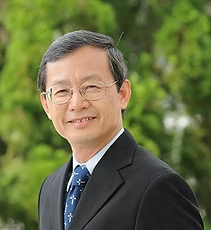
Dr. Liu Yizhang
I. The Issue of “Hakka Identity (Hakka People’s Identity)”
Hakka identity” has always been a topic of concern among the Hakka people, and it can be traced back as early as the late 17th century (more than 300 years ago) to the Qing government’s “Repopulation” policy. In the early Kangxi period, after the Zheng regime, which used Taiwan as a base to resist the Qing and restore the Ming, collapsed, the Qing court, for considerations of national border security and economic interests including taxation, adopted preferential policies to encourage people from Jiaying Prefecture (in present-day Meizhou) to migrate to the Pearl River Delta, including Xin’an County (including the Hong Kong region), to cultivate land and settle. The people from Jiaying Prefecture who migrated to this area differed from the indigenous Cantonese people in dialect and living customs, and were therefore called “Hakka.” These “new migrants,” who lived adjacent to the Cantonese, then referred to themselves as “Hakka.” Later, they brought this originally “other-given” name back to Jiaying Prefecture, and the local people gradually began to call themselves “Hakka.”
The earliest existing document discussing the issue of “Hakka identity” is Fenghu Miscellaneous Notes (1808), preserved from Xu Xuzeng of Fenghu Academy in Huizhou explaining to students the “difference between locals and guests.” Xu Xuzeng was a Hakka from Zengcheng; he elaborated that the Hakka language and customs were similar to those of people from the Central Plains, and believed that the Hakka people were descendants of Han people who migrated south from the Central Plains. In the 19th century, missionaries who came to China noticed the cultural characteristics of the Hakka people, discovering that whether in dialect, division of labor between men and women, or daily living habits, they were different from the Cantonese and Teochew people. They were especially impressed by the fact that Hakka women did not bind their feet and by their hardworking and enduring character. The Guangdong Local Geography Textbook published in 1907 stated that “the Hakka are neither Cantonese nor Han,” and the English World Geography published in 1920 even described the Hakka as “barbarians.” These erroneous and discriminatory viewpoints prompted Hakka scholars to rise up and write to refute them. Hakka people in various places initiated the establishment of associations, hoping through the efforts of organized groups to gain recognition of the Hakka people’s identity as Han Chinese.
In 1971, the Hong Kong Tsung Tsin Association celebrated its 50th anniversary and invited about 250 representatives from 49 Hakka associations around the world to participate in the Golden Jubilee celebration. This grand event united Hakka people from all over the world. The organizers established the “World Hakka Association” (“World Hakka”) to continue and promote the Golden Jubilee, which symbolized the spirit of unity among Hakka people worldwide, and resolved to hold regular conventions in the future.
The headquarters of the World Hakka Association is located in Taipei, and its purpose is: “to promote the Hakka spirit, strengthen the unity of Hakka people, and consolidate their collective strength; to promote and convey the industrial, commercial, and cultural activities of Hakka people around the world; to enable Hakka people in various places to further understand and unite with one another, so that the fine traditions of the Hakka people—courage, perseverance, and hardworking spirit—may form a respected organizational force throughout the world.” The “World Hakka” is the overall organization of Hakka people worldwide and is responsible for organizing successive World Hakka Conventions, which have been held nearly thirty times to date. The “World Hakka” has also initiated the organization of the “World Hakka Cities Leadership Conference,” providing a platform for elites from Hakka cities around the world to exchange ideas, so as to jointly discuss the welfare of Hakka people and related undertakings; it co-organized the first conference in 2004 and the 2005 conference with the Hong Kong Tsung Tsin Association, playing a positive role in promoting the unity of Hakka people worldwide.
Hakka people at home and abroad are concerned about the preservation of Hakka language, history, and culture, and they especially cherish their identity as Hakka people. In 1994, the World Hakka Convention was held for the first time in the Hakka ancestral homeland, and thousands of Hakka compatriots gathered in Meizhou, the “Hakka capital.” They attended the conference with excitement, not only witnessing the development of their motherland but also being able to worship their ancestors in their hometown, and everyone felt great satisfaction. Many overseas Hakka are engaged in industry and commerce, and governments at various levels in mainland China attach importance to the regularly held “World Hakka Convention,” regarding it as a good opportunity to attract overseas Hakka compatriots to return to the country for inspection, tourism, and investment. Hakka people in Taiwan have also moved from being “invisible” in the past to stepping onto the front stage. In recent years, Hakka Affairs Committees established in multiple counties and cities, as well as the Hakka Affairs Council of the Executive Yuan established in 2001, are public resources responding to the Hakka people’s demands to “return our mother tongue” and to pass on Hakka culture. The Hakka Affairs Council has convened the “Global Hakka Cultural Conference,” providing a platform for Hakka people around the world to exchange on how to inherit and promote Hakka culture, while also allowing Hakka compatriots to fellowship and build networks. Today, “Hakka identity” is no longer an issue; Hakka people, together with the brotherly ethnic groups and dialect groups of the Chinese nation, continue to strive side by side for the rejuvenation of China.
II. The Origin and Early Development of the Hakka Gospel Movement
Today, the border areas of Fujian, Guangdong, and Jiangxi provinces are called the Hakka ancestral homeland; outside the homeland, large numbers of Hakka people also live in Guangxi, Sichuan, and Taiwan, as well as in overseas regions such as Southeast Asia, South Africa, Europe, the Americas, and Oceania. According to one estimate, the global Hakka population is about 70 million. This article provides a brief introduction to the early history of the spread of the Christian faith among the Hakka people and the current situation of the Hakka Gospel movement.
Christianity encountered the Hakka in the 1830s. The first to preach among the Hakka people was Rev. Karl Friederich August Gutzlaff (1803–1851) from Europe. Gutzlaff was from Prussia, Germany. He graduated from the Berlin Missionary Institute in 1823 and then pursued further studies at the Dutch Missionary Institute in Rotterdam. On the eve of his departure for the Asian mission field, he visited Rev. Robert Morrison, who had just returned to England from missionary work in China. Influenced by him, he developed a desire to preach the gospel to the Chinese people. In 1827, he was sent by the Dutch Missionary Society to Java in the Dutch East Indies. The following year, he left the Dutch Missionary Society to become an independent missionary, focusing on preaching the gospel to the Chinese. While preaching in Batavia (present-day Jakarta), he was influenced by the “itinerant evangelism” approach of Rev. Walter Henry Medhurst (1796–1857) of the London Missionary Society. Between 1831 and 1833, he traveled three times along the coast of China and distributed gospel tracts. At that time, the Qing government still enforced a ban on Christianity, so he could only preach the gospel among Chinese migrant communities in the Malay Peninsula and nearby Southeast Asia, during which he learned dialects such as Minnan, Teochew, Cantonese, and Hakka.
Gutzlaff later moved from Southeast Asia to Macao, and after the Opium War, he moved again to Hong Kong in the following year; he was appointed by the British Hong Kong colonial government as the first Chinese Secretary. At that time, seeing the vast field for evangelism, he wrote respectively to the German “Three Basel Mission Societies”: the Basel Mission (The Evangelical Missionary Society of Basel), the Rhenish Missionary Society at Barman, and the Berlin Missionary Society, calling on the “three societies” to send missionaries to China. In his letters, he “strongly stated that the Hakka regions of Guangdong could develop missionary work, and this was highly appreciated by the mission established by German and Swiss believers in Basel, Switzerland.” Churches immediately responded to his call and sent missionaries eastward. Among them, missionaries of the Basel Mission and the Rhenish Mission respectively specialized in preaching in Hakka-speaking and Cantonese-speaking regions, while missionaries of the Berlin Mission preached in both areas. In 1844, Rev. Gutzlaff established the Chinese Union in Hong Kong (meaning “that the Chinese may believe in the Way and receive blessings”), preaching to the grassroots of Chinese society, mainly targeting the Hakka people.
The Basel Mission later focused its evangelical work on the Hakka regions. Early missionaries included Rev. Theodore Hamberg (1819–1854) and Rev. Rudolph Lechler (1824–1908). Through their efforts, the Gospel began to spread among the Hakka people in eastern Guangdong. During his evangelistic work, Rev. Hamberg became acquainted with Hong Xiuquan, the leader of the Taiping Heavenly Kingdom (a Hakka from Hua County, present-day Huadu District, Guangdong), through Hong’s cousin Hong Rengan. In 1852, Hong Rengan began studying Christian teachings under Rev. Hamberg, and the two developed a close teacher–student friendship.Rev. Hamberg later authored the earliest historical account of the early Taiping Heavenly Kingdom, based primarily on interview records with Hong Rengan. Li Zhenggao, a Hakka Christian who studied under Rev. Hamberg and later joined the Taiping forces alongside Hong Rengan, became the first Hakka pastor.At the same time, Hong Rengan absorbed Western ideas of national prosperity and strength taught by Rev. Hamberg. He later compiled the “New Treatise on Aids to Administration” (Zizheng Xinpian), which became the first important blueprint in China’s century-long pursuit of modernization.
Medical Missions Basel Evangelical Missionary Society missionaries successively preached the Gospel in Hakka regions such as Hong Kong, Bao’an, Dongguan, eastern Guangdong, and Taiwan, and at the same time devoted themselves to medical, educational, and social relief work. In 1924 the Basel Mission in China implemented self-propagation, self-support, and self-governance, and changed its name to “Chinese Christian Tsung Tsin Mission,” meaning “to worship the true God and revere the true Way.” “According to the 1948 statistics of the Lao Long Tsung Tsin General Association: in Guangdong Province there were 25 districts (churches), 167 branch churches and preaching stations. The number of members was 19,678.” The Basel Mission (Tsung Tsin Mission) established hospitals and clinics in Hakka regions, successively founding Meixian Deji Hospital (now Meixian Huangtang Hospital) in 1893 and Heyuan Renji Hospital in 1907. In addition, a blind girls’ home was established for orphaned and helpless blind girls, and they were taught skills such as sewing. After the 1950s, the Tsung Tsin Mission continued to carry out medical and charitable work in Hong Kong, providing urgently needed social relief services to post–World War II Hong Kong society, which was in great need in all areas.
2 Education Work
Basel Mission missionaries very early paid attention to the education of the Hakka people. They compiled Hakka-language readers as textbooks for teaching the Hakka people, greatly raising the cultural level of the Hakka people. In Hong Kong, in 1862 Mrs. Rudolph Lechler opened a girls’ school at the Sai Ying Pun Salvation Church, named Basel Yi School, “using Hakka language as the medium of instruction, thus this church is also the birthplace of the Hakka Christian church girls’ school.” Up to 1946, the Basel Mission (Tsung Tsin Mission) had 30 schools in the Dongjiang, Meijiang and Zhujiang regions of Guangdong Province. Including: 5 lower primary schools (distributed in Kui Chung, Gongzhuang, Anliu, Laotian and Dabuping), 21 complete primary schools (distributed in Sham Shui Po, Langkou, Yong’an Village, Guzhu, Mabei, He Wan, Heyuan, Jinkou, Heping, Laolong, Lankou, Heshil, Mulin, Yankeng, Wuhua, Shuizhai, Zexia, Songtou, Qiling, Pingtang, Meixian), 3 middle schools (Meixian Leyu Middle School and Guzhu Ledao Middle School, both running senior and junior middle sections; Wuhua Lexian Middle School, junior middle section), and 1 seminary. The number of students was 3,962 (including 676 female students), teachers 144. Because Leyu Middle School had a German department, it indirectly also trained many talents for China in medicine and engineering fields. Today, the Hong Kong Tsung Tsin Mission runs 6 middle schools, 4 primary schools, 7 kindergartens and 1 early childhood center, distributed across Hong Kong Island, Kowloon and the New Territories.
- Hakka Homeland Church Training Ministry Plan
- Taiwan Hakka Gospel Movement
- Faith and Migration: The Spread of the Gospel among Hakka People in North Borneo
In the second half of the nineteenth century, a large wave of migrants from Fujian and Guangdong went overseas to seek a livelihood, including many Hakka Christians. As they migrated from their homeland to Southeast Asia, including Borneo (known among Hakka people as “Ban Niao,” the Hakka pronunciation of Borneo), Hakka Christian communities gradually took shape in today’s East Malaysian states of Sarawak and Sabah (formerly North Borneo). Today, Sabah has become the region with the highest proportion of Hakka Christians in the world, with believers exceeding twenty percent. Local Hakka churches still use the Basel Mission name. The Hakka churches in Sabah are flourishing and have established the world’s largest Hakka seminary. We look forward to the Hakka churches in Sabah, Malaysia, becoming a central pillar of the global Hakka Gospel movement in this century, expected to exert their strong influence in spreading the Gospel. The “Love Hakka, Gain Hakka: 2013 Global Hakka Gospel Conference” organized by the Global Hakka Gospel Association was held on September 19–22 this year in Kuching, the capital of Sarawak. This was the third Global Hakka Gospel Conference.
Here we introduce the Miri Gospel Chapel in Sarawak as an example of the spread of the Gospel to overseas Hakka people. The Miri Gospel Chapel began as a Hakka gospel church and later developed into a multilingual church with an emphasis on missions. In 1963, Australian missionary Rev. Percy King (1911–2005) and his wife Lydia Green (1911–2005) came to Miri, Sarawak, for missionary work and established the Gospel Chapel. At the age of 18, Rev. King responded to God’s calling and resolved to preach the Gospel in China. After graduating from seminary in 1937, he joined the China Inland Mission and was sent to Sichuan for ministry. During his missionary work in Sichuan, he also traveled to Tibet and learned Mandarin and Sichuan dialect. In 1938 he married Canadian missionary Lydia Green in Chengdu, and in 1940 they returned to Australia. From 1954 to 1972, Rev. and Mrs. King served in missionary work in Southeast Asia. In order to preach the Gospel to local Hakka people, he also learned the Hakka language. Today, Miri Gospel Chapel has developed into a church comprising 14 congregations, with 1,500 members and 700 children; and it has evolved from a Hakka dialect church into a church that now uses Mandarin as its main language. In order to reach people educated in English and indigenous groups with the Gospel, Miri Gospel Chapel has also added English worship services and indigenous education ministries.
Miri Gospel Chapel has now developed into a church that actively engages in missions, which is also because the Gospel Chapel originally began with a vision for missions. At that time, Rev. and Mrs. King, in obedience to the Great Commission of Jesus Christ to spread the Gospel to the ends of the earth, went as pioneers to Southeast Asia to preach the Gospel and establish churches. Later, Rev. and Mrs. Liu Yuhan from the Filipino Linghui Church were sent to pastor Miri Gospel Chapel (1970–1973). “After Rev. and Mrs. Liu Yuhan left, a number of pastors from the Methodist Church of West Malaysia and other denominations came to shepherd the church… At this time, Miri Gospel Chapel was still a beneficiary of missions and had not yet officially begun missionary work. A missionary church essentially moves from being a recipient to being a giver. Being a recipient is the process; being a giver is the goal.” Based on this belief of “giving,” the church established a Missions Department in 1980. At that time there was only one congregation (the mother church of Miri Gospel Chapel), with about 120 worshippers. “The following year, the first Missions Conference was held, with Elder Hsu Shu Chu from the Linghui Church as the speaker. At that time, more than half of the congregation were students… The leaders, with simple faith, set a faith pledge goal of RM10,000 for that year’s Missions Conference. At that time, RM10,000 was a huge amount for the believers. However, through simple faith, God performed a miracle, and the offering that time reached RM20,000. From then on, the Miri Gospel Chapel began its participation in global missions.” Today, Miri Gospel Chapel has developed into a “missionary church.” “As the missionary zeal and evangelistic passion continue to rise, the church constantly, and cannot stop, reflecting on how to do missions better. As a result, many related actions have been produced. In 2000 the church started an English congregation, one of the purposes being to raise more members who received English education to engage in cross-cultural gospel work. In 2004, a remedial school for indigenous people in the country was established, also with the aim of cultivating potential indigenous people to become full-time servants of God in the future. To deepen the missionary awareness and experience of the brothers and sisters, the church organizes domestic and overseas mission teams every year, and the number continues to increase; at present the church has planned to send out 14 mission teams in 2007.”
- Vision of the “Global Hakka Gospel Association”
The Hakka churches have an increasingly fervent heart for their fellow compatriots, especially for Hakka people to believe in Jesus. In order to better promote the Hakka Gospel movement and enable Hakka people scattered around the world to hear the Gospel, the “Global Hakka Gospel Association” was therefore established. The “Global Hakka Gospel Association,” initiated and organized by Tsung Tsin Mission and Basel Mission churches, has the following purpose: “To connect fellow workers who care about global Hakka missions, to work together to proclaim the Gospel of Jesus Christ; to actively lead Hakka compatriots in various places to come to the Lord, and to unite in fulfilling the mission of global evangelization.” The “Global Hakka Gospel Association” is jointly organized by Hakka churches from Hong Kong, Taiwan, Malaysia, Indonesia, and the United States and other regions and countries, and its headquarters is currently located in Hong Kong. The chairman is Rev. Luo Zucheng, Senior Pastor of the Hong Kong Tsung Tsin Mission, and the general secretary is Rev. Wu Tianhui of the Sabah State Basel Christian Church.
The second “Global Hakka Gospel Association” was held on September 17–20, 2011 in Pontianak, West Kalimantan Province, Indonesia, as the Second Hakka Gospel Conference, with the theme: “For My Kinsmen According to the Flesh.” The purpose of the conference was to explore how to more effectively spread the Gospel to the 70 million Hakka people around the world: “Gain the Hakka, preach to the ends of the earth.” The main speaker of the conference was Dr. Wen Yongsheng, Senior Pastor of Pingzhen Church of the Taiwan Tsung Tsin Mission and Honorary President of the Taiwan Hakka Mission Seminary. Pastor Wen delivered two keynote speeches titled “Identifying with the Hakka, Gaining the Hakka” and “Committed to Missions, Preaching to the Ends of the Earth.” There were 253 participants in this Hakka Gospel Conference, coming respectively from Taiwan (36), Sabah (86), Australia (2), Kuching (13), Hong Kong (11), Singapore (11), and Indonesia (94).
Hundreds of years ago, Chinese people migrated to the islands of Southeast Asia for reclamation and achieved remarkable results, among whom the Meixian Hakka Luo Fangbo (1738–1795), who pioneered in Pontianak, Borneo, was one of many resolute and courageous pioneers. Overseas Chinese have lived and multiplied in Southeast Asia for generations, contributing to the local social economy. However, since the 1960s, the Indonesian government closed all Chinese-language schools and Chinese-language newspapers. Today, except for a few areas such as Semarang in Java, Surabaya, and Medan in Sumatra, most Chinese under the age of fifty can hardly speak Mandarin; they generally only speak Indonesian and English. In May 1998, anti-Chinese riots broke out, and the Chinese suffered severe persecution, a tragic situation that shocked the world. After President Suharto stepped down and President Wahid took office, “the Indonesian government, according to a policy of pluralism, adjusted its policies toward Chinese people, restored the status of Chinese culture, and gradually expanded the use of Chinese language and writing, with the readership of Chinese media gradually increasing.” The status of Indonesian Chinese has thus been restored, Chinese schools have reopened (establishing trilingual schools—Chinese, Indonesian, and English), and Chinese language education has been revived. “Today in Indonesia, the trend of learning Chinese is flourishing, and many Indonesians have joined the learning movement, because proficiency in Chinese can bring them more and better job opportunities and prospects.” Attending the Pontianak Hakka Gospel Conference gave the author a deep impression that in order for the Gospel to spread among Indonesian Chinese, one must first understand the “dual multicultural” nature of Chinese people: Indonesian culture and Chinese culture, the latter including sub-ethnic cultures such as Teochew, Hakka, Hokkien, and Cantonese. Indeed, integration into the local mainstream Indonesian society is the necessary path for Chinese people. However, the Chinese cultural heritage they carry still retains considerable vitality. With China’s continuous rapid economic development, more and more people around the world, including overseas Chinese, are enthusiastic about learning Chinese, sending their children to China to study Chinese culture and language. Southeast Asian Chinese, including Indonesian Chinese, live in a multicultural social environment; they must adapt to the indigenous culture of their country while also inheriting the various cultural changes experienced over several generations or even more than ten generations after migration overseas.
- Conclusion
The history and present situation of the spread of the Gospel among the Hakka people over nearly 170 years still require in-depth and comprehensive discussion and research. This article is only a preliminary attempt. Today, the global Hakka population is approximately 70 million, and the proportion of believers is lower than the average among Chinese people. In the past decades, Hakka churches have been concerned with how to strengthen evangelism among the Hakka people, and the Global Hakka Gospel Association was established to promote Hakka gospel ministry. In Taiwan, the Hakka Gospel Association has in the past ten years launched the “Doubling Movement,” with the aim of doubling the proportion of Hakka Christians from 3 percent to 6 percent within ten years. Sabah, Malaysia, is the region in the world with both the highest proportion and the largest number of Hakka Christians, whether in terms of population ratio or total number of believers. The author hopes that Hakka gospel ministries in other parts of the world will follow the example of Taiwan and Sabah, and fully commit themselves to obeying the Great Commission entrusted to us by the Lord Jesus Christ: to spread the Gospel to the ends of the earth, including every corner of the Hakka people.



Leave a comment